
Now Boarding • January 2027 •
Now Boarding • January 2027 •
Train the brain. Calm the storm.
Clinician-guided neurofeedback for kids and teens. Now boarding for January 2027 launch.
Request a Free ConsultationWhat is neurofeedback?
Neurofeedback is real-time, EEG-based brain training. Small sensors rest on the scalp and read the brain’s electrical activity while your child watches a screen or listens to audio. In some cases, gaming can be used to reach treatment goals as well. When the brain moves toward a calmer, more focused pattern, the program responds. Over many sessions, the brain gets better at finding that pattern on its own and using it in the real world.
Neurofeedback is not painful, not talk therapy, and not medication. Nothing is sent into the brain; the sensors only listen, the way a thermometer reads temperature. Kids often say it feels like watching a movie.
Because it isn't talk therapy, your child doesn't have to explain or process anything, which is why it often reaches kids whose progress has stalled in traditional counseling. And because it trains a skill rather than supplying a chemical, gains tend to hold after training ends. Studies show they last at six-month follow-up, and some show longer.
More than 40 years of research on neurofeedback shows quality results. Studies have linked it to stronger attention, improved response control, and gains in mood, emotional awareness, and confidence, along with broader reports of better physical and psychological well-being. Studies have found the strongest and most consistent effects on inattention, with gains that tend to hold at six-month follow-up. While larger controlled trials are still needed, reviews have found it promising enough to warrant continued clinical use. We'll tell you honestly where the evidence is strong and where it's still developing.
Who it helps
A child who can't settle enough to start homework, or can't stop once they've started
Big emotions that arrive fast and take a long time to come back down
Worry that shows up as stomachaches, refusal, or a kid who won't leave your side
Trouble falling asleep, or a brain that won't switch off at bedtime
Tips, tricks, and trainings that make sense but don’t stick
A teen who says "I know what I'm supposed to do, I just can't make myself do it"
Progress in counseling that has stalled
Neurofeedback works wonderfully for many, but not for everyone. Through our assessment process, if we don't think it's the right tool for your child, we will say so. The consultation exists to answer that question honestly.
Your clinician tracks the data
“I use the readouts, assessments, and your parent feedback to guide and adjust treatment as it develops.”
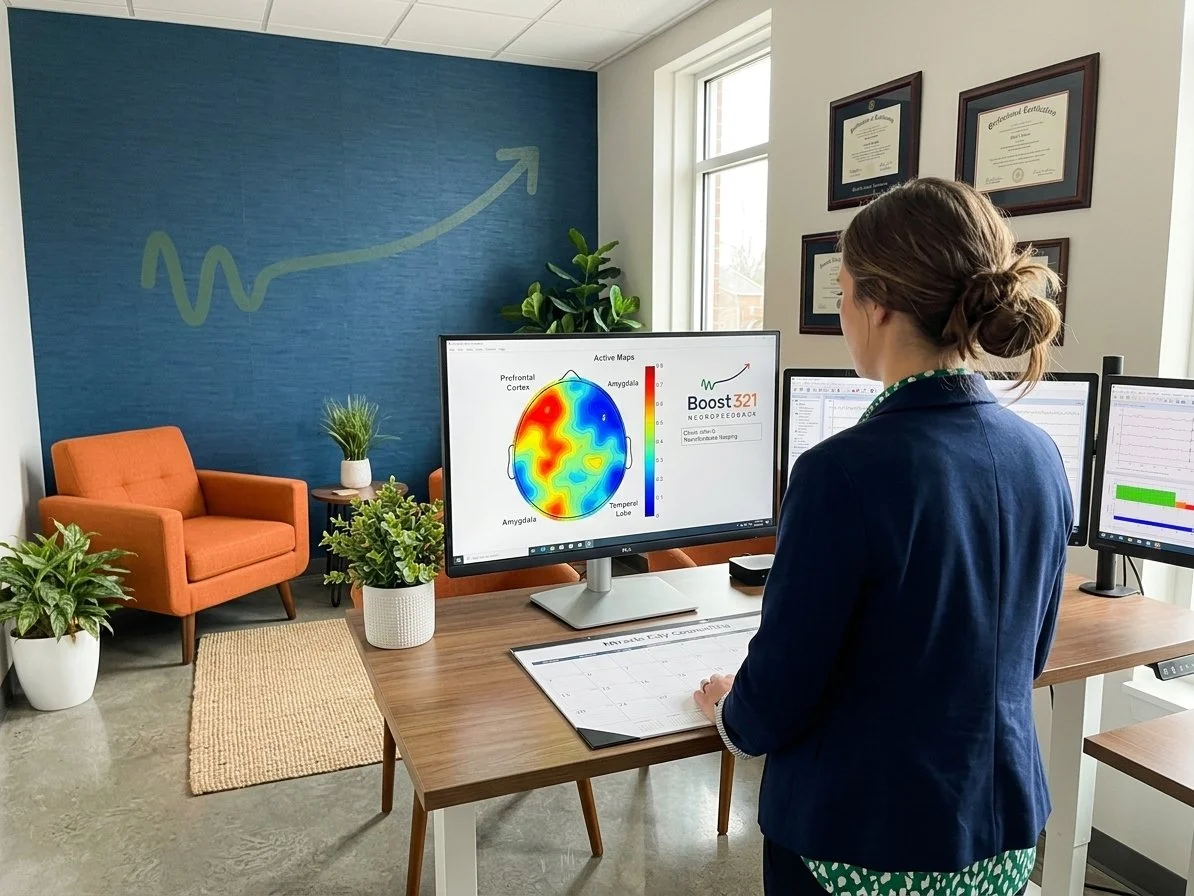
A lot of neurofeedback programs are simply run by a machine with the hopes it’s targeting well. But our program employs a licensed counselor and a trained technician to retain the human touch and therapeutic value. Put simply: if something isn't working, we change it.
Kailey Mahan, LMHC, who has more than 12 years of experience with children, conducts the initial treatment planning, mapping, and subsequent progress monitoring. The clinical technician equips and monitors your child throughout each session. This way, the protocol follows your child instead of running unchanged for three months.
How the process works
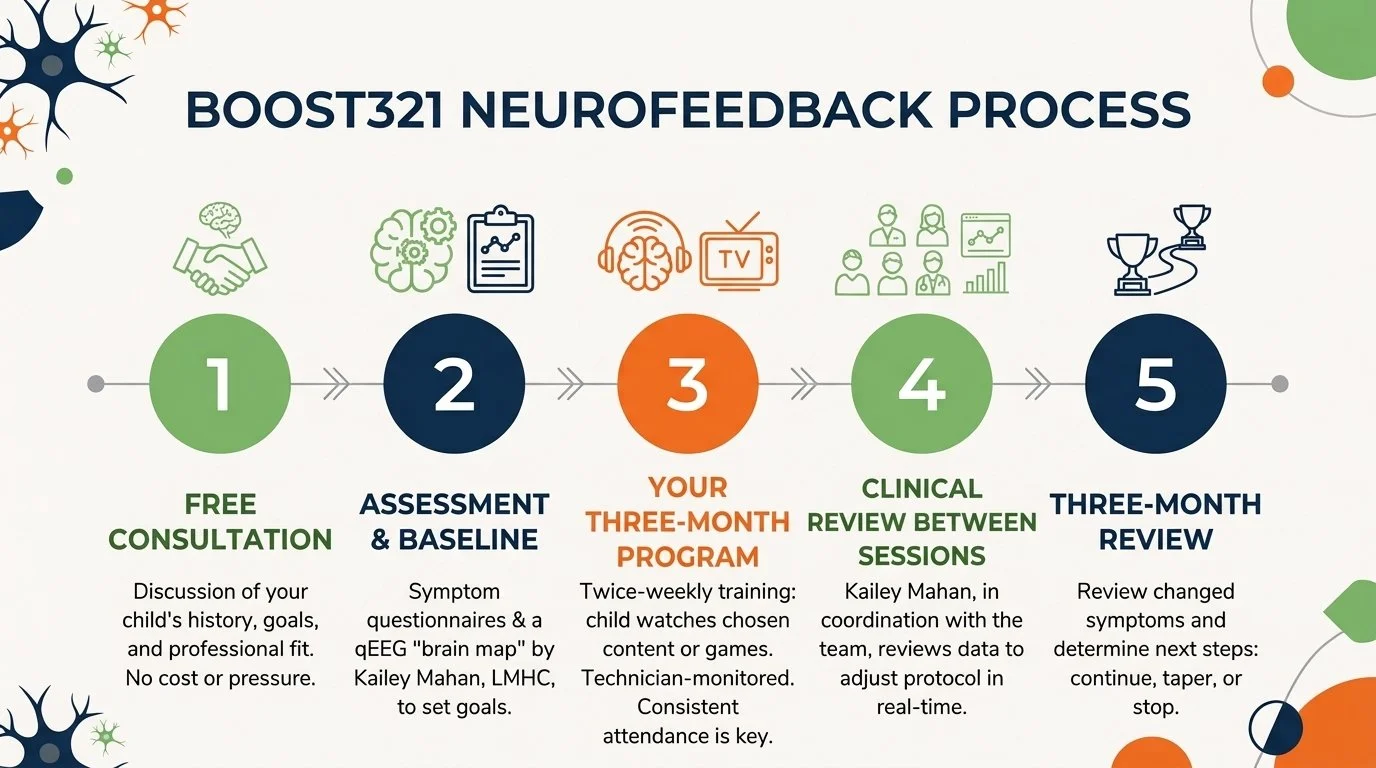
Free consultation. You and Kailey Mahan will talk through your child's history, what you're hoping changes, and whether neurofeedback is a reasonable fit. No cost, no pressure.
Assessment and baseline. We provide questionnaires as a baseline of current symptoms, and to measure progress as we go. Kailey Mahan, LMHC, then completes a “brain map” for your child, and finally, we collaborate with you to set the training goals.
Your three-month program. In our twice-weekly sessions, your child’s brain is trained through watching chosen content and sometimes through targeted games. The clinical technician equips and monitors your child’s session. Consistent attendance is key for the brain to identify and implement improved pathways.
Clinical review between sessions. Kailey Mahan, in coordination with you, your child, and the technician, reviews the data and adjusts the protocol to match what the brain is actually doing.
Three-month review. We sit down with the full picture, show you what changed, and decide together what comes next — continue, taper, or stop.
A small program, on purpose
We're currently taking a small cohort of neurofeedback clients. That's how many children we are committing to support, train, and monitor with excellence as the standard.
It also means this works best for families who can commit: two 45-minute sessions a week for three months. Consistency is what trains the brain. If that schedule isn't realistic right now, it’s something to aim for; we can discuss different treatment timing and save your child a spot in a later cohort.
Investment and payment
3 Months. 2 Sessions per week. 1 Brain, trained.
Research shows that neurofeedback has the strongest results when offered as a three-month program. You can choose to pay in installments, or fully up front for a discount.
Using your FES-UA scholarship
Florida's Family Empowerment Scholarship for Students with Unique Abilities (FES-UA) can be used on neurofeedback! We are already an approved provider in their Marketplace.
There is no household income limitation.
Eligibility can be established with an IEP, or a documented diagnosis from a physician or psychologist.
Funds sit in an education savings account you control, deposited quarterly.
Families can reserve the monthly or the full payment in Marketplace, and FES-UA will pay us directly!
Not sure whether your child qualifies? Ask us. It's a short conversation in the consultation and we'll talk you through the steps.
Frequently asked questions
-
No. The sensors only read activity; nothing is sent into the brain. There's no shock, no current, no needle.
-
Children who can sit for 30 minutes of TV or gaming are capable of receiving this treatment. Sessions are about 45 minutes, including setup.
-
Sits comfortably and watches a screen or listens to audio. That's it. Many kids find it relaxing; others find it fun; some find it boring, which is fine — being bored doesn’t interfere with the training.
-
That's not a promise we make. Neurofeedback works alongside your child's existing care. Any medication decisions stay between you and the prescriber. That said, research suggests gains from neurofeedback tend to last after training ends. It isn’t masking symptoms; it’s designed to train the brain to manage them.
-
Most plans don't cover neurofeedback yet. Paying directly means the plan is built around your child rather than a billing code — and FES-UA families can use scholarship funds.
-
You'll see the data at your three-month review, alongside the goals we set at the start. We'd rather tell you if it isn't working than keep billing you.
-
Your three month treatment plan is designed around the science: 20 sessions is the minimum to assess progress and decide next steps. Missed sessions can be rescheduled or added to the end of treatment.
Refunds and early withdrawal. Your payment secures 20 sessions minimum. For refund purposes, the program is valued as an assessment fee of $300 plus $165 per secured session ($300 + 20 × $165 = $3,600). To withdraw, notify Kailey Mahan, LMHC in writing.
Further terms and conditions are outlined in the consent forms you sign prior to treatment.
Start with a conversation, not a commitment.
The consultation is free and we welcome all questions! We'll discuss what's going on with your child, explain what neurofeedback can and can't do, and tell you honestly whether it's worth your time and money.